Madam C. J. Walker's Gospel of Giving by Tyrone McKinley Freeman
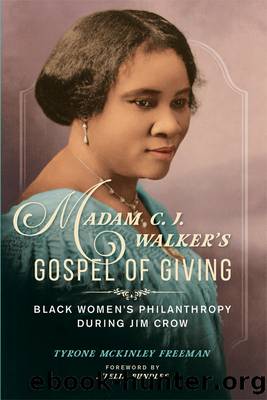
Author:Tyrone McKinley Freeman [Freeman, Tyrone McKinley]
Language: eng
Format: epub
ISBN: 9780252085352
Barnesnoble:
Publisher: University of Illinois Press
Published: 2020-09-29T00:00:00+00:00
Gift Categories
Through Ransomâs letter, Madam Walkerâs gifts can be categorized as monetary, tangible nonmonetary items, employment, and institution-building. The bulk of the letter focused on the typical category of monetary gifts as philanthropy. Ransom presented twelve of Walkerâs monetary gifts. Amounts were not given for two of the gifts, but the remaining ten ranged from $5 to $1,000 and totaled $1,550 for the three-year period. The $1,000 gift was the famous pledge to the local colored YMCA. It was an outlier on the list because five of the gifts were for $50 or less, and four were for either $100 or $200. It was instructive, however, that Ransom led with this gift because it was clear both he and Walker wanted many people to know about it and the significance of not only its amount, but of its sourceâa black woman who owned a business and used her resources to uplift the race during Jim Crow. Charitable giving met important needs and demonstrated respectability and virtuous womanhood, too.
Walker tended to make the gifts of $50 or less to smaller, local organizations such as Flanner House in Indianapolis, the Star Christmas Fund, the Mite Missionary Society at St. Paul AME Church in St. Louis, and the St. Louis Colored Orphansâ Home. These local organizations were vital to their surrounding communities. Faced with gaps in services created by the discriminatory practices of white mainstream social-service organizations, these black-serving organizations were essential to survival in the black community.6 In 1916 the Indianapolis Freeman reported that Walker had a history of visiting poor families in the city several times per year to âattend to their needs.â7 Her own private visits to families and public gifts to charities represented her efforts to combat poverty. Walker appears to have made several small donations to these organizations over time. Such a pattern likely represented her understanding of the importance of continuous support for vulnerable organizations. A steady stream of smaller gifts better addressed organizationsâ long-term cash-flow concerns than did one-time gifts of larger sums that often left organizations scrambling to find replacement donations after their expenditure.
Walker had tended to make the gifts of $100 or more to relatively larger organizations with regional, national, or international programs. For instance, such gifts went to Palmer Memorial Institute, which educated students throughout North Carolina and the South; the âState Universityâ in Louisville, Kentucky; and the International YMCA.8 Her $200 gift to Charlotte Hawkins Brownâs Palmer Memorial Institute covered one teacherâs salary.9 The $100 gift to âState Universityâ was made in honor of Alice Kelly, Walkerâs tutor, assistant, and frequent travel companion, who had worked as a teacher in Kentucky, and Lucy Flint, Walkerâs bookkeeper.10 The gifts were commensurate with those made by white northern donors and frequently totaled more than what was given in the aggregate by black donors and southern white donors.11 These monetary gifts were the most represented type of gift in the letter, but they were complemented by examples of nonmonetary giving that provided added dimension to Walkerâs gospel of giving.
Download
This site does not store any files on its server. We only index and link to content provided by other sites. Please contact the content providers to delete copyright contents if any and email us, we'll remove relevant links or contents immediately.
| Civilization & Culture | Expeditions & Discoveries |
| Jewish | Maritime History & Piracy |
| Religious | Slavery & Emancipation |
| Women in History |
Cecilia; Or, Memoirs of an Heiress — Volume 1 by Fanny Burney(32637)
Cecilia; Or, Memoirs of an Heiress — Volume 2 by Fanny Burney(32011)
Cecilia; Or, Memoirs of an Heiress — Volume 3 by Fanny Burney(31997)
The Secret History by Donna Tartt(19306)
Sapiens: A Brief History of Humankind by Yuval Noah Harari(14464)
Leonardo da Vinci by Walter Isaacson(13412)
The Radium Girls by Kate Moore(12095)
Sapiens by Yuval Noah Harari(5410)
How Democracies Die by Steven Levitsky & Daniel Ziblatt(5272)
The Wind in My Hair by Masih Alinejad(5140)
Homo Deus: A Brief History of Tomorrow by Yuval Noah Harari(4962)
Endurance: Shackleton's Incredible Voyage by Alfred Lansing(4845)
Man's Search for Meaning by Viktor Frankl(4671)
The Silk Roads by Peter Frankopan(4586)
Millionaire: The Philanderer, Gambler, and Duelist Who Invented Modern Finance by Janet Gleeson(4539)
The Rape of Nanking by Iris Chang(4262)
Joan of Arc by Mary Gordon(4157)
The Motorcycle Diaries by Ernesto Che Guevara(4151)
Stalin by Stephen Kotkin(4007)
